Category: notes of interest

  • It’s Quit MySpace Day

    Quit MySpaceToday you will quit MySpace. Whether you’re a band, musician or just a fan with a (forgotten) account there, you have to go delete it now.

    Why?

    Exactly a year ago Andrew Dubber posted his idea of Quit MySpace Day. I posted about it too in May. His statement was simple: MySpace is very crappy as a social website as well as a band platform: it’s ugly & cumbersome (always has been), the music-interface is awful, people overload them with pictures & videos and the only messages we get are friends-invites and messages of unknown, crappy bands who are spamming the whole world about their new tour or album. Not to mention it’s owned by a big corporate news media company that stopped caring about MySpace too. When is the last time you logged in or thought MySpace had really helped you achieve something as a band? I bet you can list more reasons why MySpace sucks and you’re welcome to list them.

    Andrew Dubber gave MySpace a year to improve and guess what? They didn’t. So as a signal to MySpace that they have failed us for the last time, it’s time to leave. Not just log off, but delete all our accounts starting today to make sure they understand we have left for good.

    But I need MySpace!

    No. You. Don’t. And you know it. There’s tons of better ways as a musician to spread your music and connect with your fans or for you as a fan to connect to bands:

    Just to name a few. I hear you say: “But MySpace is my band’s website!” For the last frigging time:  MySpace should never be your ‘band website’. Unless you really don’t want the world to take your band seriously.

    Ok, I’m in. what do I do?

    1. Follow the step-by-step manual to delete your account.
    2. Spread the word (Twitter #quitmyspaceday , Facebook or your blog).
    3. Enjoy your freedom.

    Good luck and thanks for joining in!

  • Muzikantendag 2010 (The Hague)

    Went to the Muzikantendag (Musicians Day), an event organised by the Dutch Copyright organisation BUMA/STEMRA (yeah, I know), which again turned out to be quite useful. It was not as crowded as last year and there was less to do, but I guess that’s also cause they split it up over two dates and veneues (there’s one in Haarlem in two weeks). Basically for most starting musicians it’s THE opportunity to give their demo’s to (Dutch) industry professionals for a listen, but I’m there for the lectures and Q&A’s. I’m glad I went this year, cause I was kinda doubting, but it worked really inspiring. I wanna make more music!

    Short overview of what I saw:

    Opening by Lucky Fonz III
    Singer-songwriter who, in my view, isn’t really a perfect musician or singer (or musically appealing to me), but he proves the point that personality is much more important. A lot of musicians for get that. He also gave a great talk.

    How do I get gigs?
    A booker from Mojo (Jeps Salfischberger) and a booker from local venue Speakers in Delft (Gideon Rozendaal) explained the mechanics of how you get booked, how much you can expect to get paid (short answer: not a whole lot and you’re not gonna get booked if you can’t guarantee a crowd will show up). They underlined a thought that I have been playing with: start small. Really small. And work up from there.

    Producing

    Dries Bijlsma, the producer of hiphopper Typhoon,  explained exactly how he made tracks from scratch (including this one). When they asked for a bpm to make a song right then and there, I suggested 140 bpm, they were kinda shocked. Sorry, I’m hardcore. ;) Bijlsma gave quite a few interesting ideas I might wanna try out myself to create beats. Had a short talk with him afterwards about rights and people helping out with tracks. Might have a few for crowdsourcing thanks to that.

    Ralph Murphy – Murphy’s Law

    Song-writer Ralph Murphy, author of Murphy’s Laws of Songwriting, gave a mini-masterclass of how to write not a song, but a hit. Though not geared to writing the kind of music I have in mind, Murphy has some great anecdotes, advices and is generally a pleasure to listen to. I like the fact that he studies music purely out of a certain scientific curiosity, some times even researching songs he doesn’t like. He also managed to make me fill up three pages in my note book worth of notes, the most of any session.

    Online Marketing & Distribution

    This session was kinda disappointing cause there were a lot of things I there I kinda already knew. Alexander Mooij had a lot of interesting things to say and I guess mentioning Trent Reznor is always cool points, though everyone kinda knows about his marketing ploys, nothing new there.  Bart Snoeren frm 3fm/3voor12 gave some really interesting insights on how to get on Luisterpaal. Andy Zondervan despite being from BUMA/STEMRA showed that their organisation is thinking about the future and more fair systems for online content. Also thanks for point out ‘I want a pony’ Krause. Name-dropping helps discovering new music.

    How do I release my own album?

    The drummer of The Tunes and Lucky Fonz III talked about how and why to release your own album, without outside help. Short story: you make more money, but you also have to do a lot of (tedious) work. And as long as you’re a small artist, that’s okay. Also, you don’t have to sign with a record company to get your album out, just getting a distributor might be enough. And lets you keep your own rights. Got some good ideas and tips out of this session, especially with what I have in mind.

    There were a few more sessions after that (about/by BUMA/STEMRA), but since I’m too cool for school, I skipped those and went home earlier for a good meal. After all I wasn’t there to drop off a demo or exchange business cards, but just for industrial espionage. LOLZ Please remind me next year, when I doubt if I should go, then I SHOULD go.

  • The Piracy Metaphor

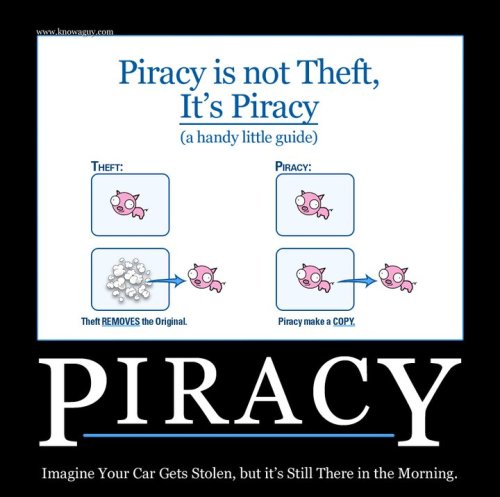
    Today in the comments of an article about illegal downloading in the free newspaper DePers.nl I found the best mataphore that explains what’s wrong with current entertainment industry. I just had to translate it for you:

    Let’s say you’re an artist. You paint beautiful abstract artworks that are respected by many and are eventually displayed in a gallery.Woops, turns out the gallery is a very profit-driven organisation. They sell posters of your artwork for ridiculously high prices and most people just decide to buy them because it’s all they can get.

    But there are a few sneaky visitors who stand in front of the artwork, take a picture and then print them out at home on high quality photo paper, completely for free. How can they do such a thing?! The gallery should have posted guards next to your artwork, pity.

    But the gallery is getting angry at the fact the sales of their posters is dropping, so they whine through organisations that say they are protecting your rights, that they want these protesting ‘thieves’ to pay for their posters. The consequence is that the police kicks in doors and rips the illegal posters down, fines the ‘thieves’ and sees to it the gallery profits once again.


    Does that sound like justice? The artists produce, they don’t distribute. That’s the record company’s task.


    I too get frustrated anyone pulls the ‘theft’ argument. As a musician, I really don’t see why I should let people pay to copy files from me or even if they copy it from their mates. They can throw a tip in my hat (or buy me drink) or pay me to put it on a disc for them as a service.

    Music is something abstract in the air, cd’s are a physical product. And as far as I’m concerned copyright laws should be mainly concerned with preventing other people from pretending they made the music you made or music being abused against the specific wishes of the creator (for instance if neo-nazi’s decide to use your music as a theme song). And even then, there’s room for debate. Just see my posts on the origin of samples. As long as no one else is making money off your work, who cares?

    But let’s face it, right now copyright laws are being used not to protect the rights of the creator, but the person selling it. And they are trying to argue with people who have no financial gain themselves by spreading the music. They’re spreading the love.

  • Artists make more in the file-sharing age

    Here’s an interesting study from Norway as posted by TorrentFreak. Artists are making more, especially from live gigs then they were some 10 years ago. Some obvious notes here however is that the focus is on Norwegian musicians. And that includes the people who don’t live off music. In that sense the study does not surprise me, but it also shouldn’t be made into something bigger than it is.

    The ‘common musician’ has more opportunities to let, friends, family and fans know they have music out and let them listen to it. In 1999, more musicians had to sell their cd’s at gigs before people could listen to them in their home, now more people listen to music in their home first and then come see the musicians perform live music.

    Most common musicians are not signed to a label. The TorrentFreak is hinting that ‘the music industry’ isn’t doing all to bad and thriving. I think they are confusing ‘record labels’ with ‘music industry’. If you see ‘the music industry’ as the entire market of people selling music, then yes, it’s thriving. But the record companies see their share in that dwindling and they are not doing well at all (ask EMI).

    It is indeed the artists that are profiting more at the expense of the record companies. That is good news. At least for the Norwegian industry.

  • Ten Tips For Doing Something New

    I often hear a lot of musicians proclaiming they’re going to do something new. Usually it means they’re going to do something different and more specifically it means they’re just going to do something different for them. And sadly, often these musicians still only produce something similar to what they were already doing. I know, cause I’ve often too said I was going to do something new.

    Doing something authentically new in music is harder than it sounds (pun not intended). And though doing something different may lead to something new, there is no guaranteed success. And even then, when you have produced something really new, it might still be unlistenable avant-garde crap no one wants to hear. But regardless of this doing something new (or different) won’t happen if you stick to the same roads. Here’s a list of 10 things I can recommend you can try to make something truely new (or different):

    1. DO find new collaborators, people you have never worked with, people you don’t know. You can place ads on (local) websites or the local practice centre notice board. You can ask musical friends about people they work with. DON’T keep recruiting the same people you’ve worked with in all your previous bands.
    2. DO try to make music all by yourself, instead of relying on the time, effort, charity and genius of others. It will also allow you to work without compromise to something that’s uniquely yours. DON’T worry if you make music all by yourself, you won’t be able to play all the instruments live or all instruments at all. Think in possibilities, not restrictions. If need be you can always get in people later to help you out.
    3. DO try out new instruments. And by that I don’t mean buy a new guitar. Try a theremin. Try a weird plugin for your composing software. Skip the default settings on your instruments and try out all the knobs and settings. Especially if they’re not in the manual. Try some websites that lets you make weird noises. Sample noises you hear outside or on tv and find a musical application for it. Give yourself a challenge. It doesn’t mean you have to stop using your favourite instrument altogether, but realise there’s more things that make noise outside drums and guitars. Use them. DON’T form a default band that has one or two guitarists, a drummer, a bass-player and a lead-singer. And that includes adding one keyboard-player instead of a guitar. Trying to create something unique and new with that line-up is near-impossible. It’s been done for over 50 years.
    4. DO make piles and piles of unfinished, abandoned and/or failed experiments. Write any random idea for a song, lyric, tune or beat down or record it if possible. If necessary, just sing it into your phone’s memo recorder (if it has one). Failure is part of learning. When you’re low on inspiration or ideas, dust off these notes and recordings and sift through it. You might find that two or three bad, unfinished ideas you had on a Tuesday night, might actually make something quite brilliant when combined. DON’T try to record the final version of your Greatest Hits album on the first try. Even the Beatles wrote some crappy songs only collectors listen to these days. People will remember you for the greatest songs you made over period of time, not your failed experiments. Unless you’ve created a truly horrible monster.
    5. DO make music by trying out bits and pieces from different styles. Take things and ideas out of their original context and apply them to your style. If you love dubstep, but are used to playing metal, you might be the first to create dubstep metal. Or it might also sound like neither and be something new. Ever hear of throat singing? Arabic scales? It doesn’t mean you have to become a reggae artist when all you ever played was rock, but it doesn’t hurt to take a look in some one else’s kitchen. Try it and find out. DON’T assume or expect you’re doing something radically new, just cause you say you are. DON’T label your own music, because it will create false expectations anyhow. Even when asked, just give a vague description and others will label your music for you. Poorly. They will call you ‘rock’ or ‘techno’ or ‘folk’ or ‘electro’ even when you’re not. Don’t worry about it.
    6. DO discover new music, new styles, new musicians and new musical idols. If only for a month. Listen carefully why you feel their music is so special and figure out how to put those feeling and ideas into your own music. DON’T be a devoted fan of the same musician for longer than ten years. And certainly DON’T try to follow in their exact footsteps by copying their exact (style of) music note for note. They release a Greatest Hits after a while or usually move on to something new and so should you.
    7. DO explore new platforms to interact with fans directly, distribute music (Bandcamp, SoundCloud), connect with other musicians, create music and arrange gigs for yourself. And keep looking even after you found it. DON’T be on MySpace. It’s a shinking ship and just cause every other band is on it, means nothing. The audience is moving away from it. Also don’t try hard to get into all sorts of established music magazines or websites. Not to get noticed any how. Only hard-core music lovers and other musicians read those and if you really are hot shit, the magazines and sites will come to you.
    8. DO find new and unique venues to play. And by that I don’t mean some pub on the other side of town you’ve never been before. Is a friend opening an exhibition at an art-gallery? If you practice in your mom’s basement, why not organise your own gig there? Remember, the point is you get noticed by normal people who like the same things as you, not the few regulars who hang out at the music venues. Get noticed out of context. DON’T play at the same venues you’ve always played over and over again. It’s nice that the owner of your local practice center will let you host your demo release party there again, but after a while even your mom will stop coming to these gigs. No one new will simply show up just cause you posted a poster somewhere, when they have never heard of you. Only your fans will and how many of those have you got?
    9. DO organise your own hip events, perhaps in collaboration with other people or bands. Can’t get booked to a festival? Start your own. Create a buzz around this new thing you do, make it larger than just you. Become part of a scene, not just musically. Find people who like your kind of music and what bonds them, instead of making music that people you know might like. Let the scene inspire you. DON’T play band competitions or (televised) talent shows. The judges are usually hired to recruit what the organisers of some local festival or record label see fit as their opening act on the smallest stage they have or the next big thing to last for a month. As such they are usually not on the lookout for something new and innovative, but something that sounds a little different, but okay to an everyman audience. Unless that’s you, don’t be there. Also the other bands/artists will pretend to be nice, but meanwhile talking about how much you suck and they rawk. (Seriously, I’ve seen people do this). And you will start doing this too after a while, when you keep ending second or third without a prize. You were making music because you love it, not to please others or as a competitive sport, right?
    10. DO enjoy making music. Know that you can always be in a local blues/rock cover band who have no fans and/or do nothing new and still truly enjoy this (and some times even get paid). There is no shame in this or making a little money that way. If figuring out every solo by Van Halen in your bedroom is what you love doing, then do it. If you love playing the same songs over and over again then do it. If you love making avant-garde crap, do it. DON’T complain if you feel you can’t make something new,  no one wants to listen to your new thing or no one ever hears it. Don’t worry if no one will recognise your musical masterpiece, even after you die and it will be lost forever. You enjoyed it and that means it has served a purpose. Not everyone can be Mozart.
  • All the same beat

    Following my post earlier today, I got a reply from a reader who pointed this out to me:

    Three tracks, three artists, one producer, same song.

    All three tracks produced by the same producer and they line up perfectly. Of course this is nothing new, Linkin Park has gotten spanked for making the same song over and over again. Can you call it a clone song if it’s the same artist?

    My father’s father often commented on my dad’s music that it was all ‘the same beat’. My dad has commented today’s music is all the same beat. Maybe it’s a sign I’m getting old that I’m noticing this too. But then again, when had pop music ever not been about recycling the same ideas over and over again? Right, Warhol?

  • Slow it down … by 800%

    If you ever wanted to get into making atmospheric, ambient mood music that will blow even the most pretentious Coldplay out of the water, there’s a really simple trick to do that. The last few days on  SoundCloud, users having been posting songs that were time-stretched by 800% and the result is a beautiful soundscape you can listen to for hours. The interesting bit  though is that the songs they used for it are by Justin Bieber and Frank Sinatra. Listen to them and be amazed:

    J. BIEBZ – U SMILE 800% SLOWER by Shamantis

    Frank Sinatra – It Was A Very Good Year TIMESTRETCHED by unsignedhypenl

    Update: Make your own!

    ANd obviously there’s a rickroll version too:

    Update2:

    Slipknot turns into drone music:
    Wait and bleeeeeeeeeeed (800% pitchshift, Slipknot) by The Nevis DJ

  • Techdirt: Why Even Major Label Musicians Rarely Make Money From Album Sales

    Techdirt posts about the accounting done in the music industry. The article comes to a not-so-surprising conclusion and explains in detail:

    Why Even Major Label Musicians Rarely Make Money From Album Sales

    Shortly summarised, the artist already gets a small slice of the pie to begin with, but thanks to all sorts of contract obligations, the artist is left with very little because advances and loans need to be paid back to the record company. If that doesn’t make you follow Thom Yorke’s advice, I don’t know what will. Do it yourself or sign with a small label you know you can trust. And read the fine print.

  • NameDropper

    An interesting game by MusicMachinery.com :

    NameDropper

    The rules are simple, you get presented with a list of artists and one if them is a fake name. Can you spot the made-up artist between the real ones? So far my score is 13512.

  • Is an algorithm better than a human DJ?

    Many radio stations play compulsory playlists of the same repetitive pop crap. The alternative is listening to your own custom playlist on your computer or mp3-player or if you want to be suprised, use shuffle. There are however still radio independent DJ’s that pride themselves in making perfect playlists for you to listen to. But are they better than the shuffle button, because they introduce you to new things?

    Music Machinery is having a semi-scientific study as to whether a radio DJ, a shuffled playlist or an algorithmically composed playlist is better, according to listeners. You can read more about it and participate here. Their study results so far: the algorithmic DJ is best, the human worst. The study is far from over, so please participate.

    The interesting notion of this Turing test is that maybe computers, machines, AI, call it what you like, can make music just a well as humans can. This scares many people. They believe it will put them out of business. But that inevitably pops up the question: are you in it for the money or for the love of music? Humans will keep making music for the love of music, even if machines make better/different music. In then end machines are an extension of ourselves, so I’d rather have a machine help me make better music, then me by myself making shitty music.

    It’s like complaining about people using electric guitars and effects to make impossible music. It’s like people complaining about synthesisers , arpeggiators and all sorts of electronic aids to make impossible sounds and music. In the end, it’s tools to make better music. And if even human creativity can be emulated, why not? Ask Emmy and Emily Howell