Tag: wikipedia

  • Why there are only 12 songs in most albums

    I noticed this question on ask.com: Why are there only 12 songs in most albums? Of course I tried to create an account there to answer the question, but since it failed, here’s my researched answer to that question.

    Most record deals from major labels require the artist to record an x amount of “albums”. The record deal usually clearly defines “an album” as being a musical recording that is 40 to 50 minutes long. You can see an example of it here (in the first clause) and here (paragraph 2d). Since most pop-songs are between 3 and 4 minutes, it has become an industry standard that this means about 12 songs (4 x 12 = 48 minutes).

    Artists that have more than 12 songs usually have short ‘in between’ or ‘intro’-tracks that are just between 30 seconds to 90 seconds, but often you’ll notice the total running time of the album is still between 40 and 50 minutes, like the contract specifies.

    The line that specifies it has to be 40 to 50 minutes prevents an artist by getting off easy by recording a 20 minute ‘album’, but also prevents the artist from recording an epic work that lasts 80 minutes, that the record company could have sold as two albums.

    So why 40 to 50 minutes? There’s no limit on how large a modern digital release can be. A cd can hold 74 minutes and in some cases 80 minutes of sound. There’s even an anecdote that the cd is 74 minutes long, because Sony executive Norio Ohga felt that the London Philharmonic Orchestra’s recording of Beethoven’s Ninth Symphony should fit exactly on one disc.

    But before the cd there was the vinyl LP which can hold only 22 minutes of recording on two sides, so a total of 44 minutes. The LP was the industry standard for the longest possible recording that would fit on one disc for 30 years from it’s introduction in 1948 until roughly the 1980s when the CD was introduced. As such the ‘album’ become synonymous with a 44 minute recording, even when the CD was introduced. In the beginning this was because ‘albums’ still had to be released on both LP and CD. CD’s did some times get bonus tracks, also to lure people to buy the more expensive CD.

    But over the years, the recording industry simply held onto the ‘standard’ 44 minutes and simply loosened the definition to somewhere between 40 and 50 minutes. Or like usually … 12 tracks.
  • Google’s Moog doodle

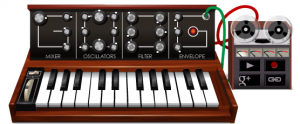
    Swwweeeeet! Check out the classic Moog Google coded and put up on their front page for Bob Moog‘s birthday! Wish he was still around to see that.

    If you’re late for the party, you can find the synth on Google’s Doodle page.

  • Daphne Oram

    On NPR an awesome article (with sound) about the Oramics machine by Daphne Oram. Daphne Oram was a composer and innovative electronic musician who worked at BBC Radiophonic Workshop (which among others worked on the sounds for Doctor Who) and later started her own workshop. One of the devices she created was the Oramics machine, an early synth which didn’t have a keyboard or anything, nope you had to draw on it. It had been lost and Daphne Oram passed away a few years ago, until recently, the machine popped up again:

    I do recommend reading the article and listening to the interview at NPR too.

  • Carl Orff – O Fortuna

    This is the last Origin of Samples post for now. It gave me great pleasure digging through the history of sampling, even discovering a few new things myself. Hopefully I can pick it up some time in the future, but for now I’ll be focussing my energy on my own music. More about that next week! For now let’s end with something epic:

    Classical composer Carl Orff”s masterpiece Carmina Burana, composed between 1935 and 1936, contains the most familiar movement of his work which has been used countless times in popular culture: O Fortuna. In music this often meant just playing it before a show to make the entrance of the artist more glorious.

    Sampling didn’t really happen until the early 90’s when KMFDM used bits of it in Liebeslied (1990) . The most infamous samplings of O Fortuna happened simultaneously in 1991 however.

    At the early peak of house music two Belgian producers sampled O Fortuna, had the songs played in clubs and decided to release it. Their bombastic track O Fortuna was released in 1991 under their recording name Apotheosis. Right in the same week, a group that called themselves Fortuna feat. Satenig released their song O Fortuna. The song was much more mellow and radio-friendly and didn’t use a sample from any recording, but clearly replayed the tunes from Carl Orff’s version.

    By this time the heirs of the deceased Carl Orff had gotten wind of this and sued. They managed to ban both tracks in the week that they were released. This meant that the cd-singles were on the shelves still on Saturday, but by Monday were all gone. I know, because I managed to snatch up a copy of the Apotheosis version the Saturday after it was announced the songs would be banned.

    The tracks entered the Dutch charts at #4 and #1 that week and then the week after dropped out of the charts completely, which had never happened before. The radio stations couldn’t play the songs (even though Fortuna feat. Satenig had made a different version with different note progression).

    Interestingly though, even though the songs still aren’t released, the original O Fortuna was sampled countless times after that. You can see the list on WhoSampled.com, but here’s some notable examples. Enigma used it twice in the track Modern Crusaders (1999) and more prominently in Gravity of Love (1999).

    In hiphop where the ego’s match the grandeur of the song perfectly, it was sampled by Nas ft. Puff Daddy in Hate Me Now (1999), by Cam’ron in Get’Em Girls (2004), Stack Bundles in Ya Dig (2006) and many others after that.

    Dance music, despite two dance tracks being banned because of the sampling, kept on using it too. Most were samples in gabber/hardcore: Chosen Few in 2006, DJ Wicked in 2000 (who actually sampled the Apotheosis track!), DJ Outblast in 2001. Even a rather more radio-friendly non-hardcore dance track O Fortuna by Hypster seems okay in 2011.

    Probably the most interesting dance version post-Apotheosis is the Anthem for the huge dance party Sensation White 2004 (annually held in a stadium) by The Rush. Though it doesn’t sample anything directly, it’s obvious what the inspiration for the track is.

    And of course there’s a few odd ones out. Ministry used it in their anti-Bush song No W in 2004. Clan of Xymox got away with sampling it in 2006 in Be My Friend. BOB released a song called O Fortuna in 2008, with different lyrics but a familiar melody. No one was sued.

    So if you plan on covering or sampling Carl Orff, apparently it’s okay if you clear the rights or make sure his heirs don’t find out about it. And with that advise I’ll end this column for now. Hit it it Carl!

  • Siouxsie and the Banshees – Happy House

    In 1980 Siouxsie and the Banshees released the song Happy House as a single. As irony has, a decade later it’s melody would be used to produce a big commercial house music hit.

    The distinguishing riff from the opening first pops up in the 1990 track Neue Dimensionen by Techno Bert. Despite the German title (and lyrics), the producers behind it were Italian and the track was released on an Italian label. My guess is that’s how Italian producer Gianfranco Bortolotti got wind of it.

    Bortolotti was the man behind Euro-dance group Capella. While he had released singles before under the name it wasn’t till the release of U Got 2 Know in 1992 that Capella scored its first massive hit throughout Europe and beyond … with the same tune from Happy House. Later Capella would get sued over this and lost.

    Spacework disregarded the melody and sampled the vocals from the original Happy House in the track Happy House in 1993, as a clever reference the the house scene that was booming at the time.

    In 2000 Mindless Self Indulgence also sampled the intro directly in their song Bitches (of which there’s a hilarious Pokemon video mashup btw). The original Happy House also got a make-over in the 2004 remix of Happy House by SFB.

    Whosampled.com also lists the bassline in Calvin Harris’ Acceptable in the 80’s from 2007 as being an interpolation of Happy House. The 2009 song Dressed to Kill by Preston however hardly hides it’s original. The Weeknd also sampled it in the song Glass Table Girls in 2011. On top of those there were also covers by Ginger Ale (2002), Celluloide(2003) and Shindu (2011).

  • Peter Allen – I go to Rio

    A few weeks back, Coldplay was in the news for yet again ‘borrowing’ some one else’s music for a song. This time though, they were honest about it and even secured the rights to do so. Their song Every Teardrop is a Waterfall takes its opening from Peter Allen’s song I go to Rio (1977).  Coldplay is not the first to sample it though.

    Apart from a French cover in 1977 by Claude François and a cover by Pablo Cruise in 1978, nobody touched the song for over a decade. In 1990 however a multitude of songs pop up, all titled Ritmo de la Noche. All of them sample I go to Rio and clearly one of them was the original and the other songs did a cover version of it.

    The people at whosampled.com did some research and figured out the first released version was by Chocolate. It had several dance remixes on the single. Also in 1990 it got released by Mystic. And by Lorca (which was probably one of the more famous versions). And by The Sacados. Oh and in 2004 Safri Duo did their own version too. It was an instant hit, though you can question by who.

    I love how all the commenters on Youtube for the different versions of Ritmo de la Nocha-versions complain about Coldplay ripping of that song while actually almost all of them are a cover from the Chocolate-version and that song samples I go to Rio. Irony.

  • Snap! – The Power

    Last week I discussed Love’s Gonna Get You by Jocelyn Brown from 1985. One of the most famous tracks that sampled it is The Power from 1991 by Snap!. The song however is surrounded by controversy.

    First of all there’s the obvious use of Jocelyn Brown’s vocals. Jocelyn Brown’s sample was used without permission or credit by the German producers behind Snap!: Michael Muenzing and Luca Anzilotti. Jocelyn Brown wasn’t pleased with that and still isn’t.

    Secondly the first version The Power sampled the vocals and music from Let The Words Flow by Chill Rob G from 1989. Originally The Power was released under the name Power Jam (feat. Chill Rob G). When all of the samples didn’t clear and they threatened to get in trouble, the producers said fuck it, and re-recorded the vocals with Turbo B, an American soldier/rapper who was stationed in Germany and re-released it as Snap!. It’s ironic considering Turbo B’s lyric “copywritten lyrics so they can’t be stolen” in The Power.

    Lastly, the music used in The Power is mainly one sample from the Mantronix track King of the Beats from 1988.  Which is silly considering they could’ve just sampled the original that Mantronix used. But more about that original next week.

    Eventually, as The Power got embedded in pop-culture, it too got sampled. The Farm’s Stepping Stone remix from 1990. Everybody by Members of Shockwave in 1995. The Ting Tings covered the song Standing in the Way of Control by The Gossip in 2008 with a sample from The Power. Hit the Floor by Big Ali ft. Dollarman from 2008. Ghettosocks used it in Take Chains Off from 2009. There’s a remix of Kanye West’s song Power from 2010 which, apart from featuring vocals by Jay-Z also features a sample of The Power.

  • Jocelyn Brown – Love’s Gonna Get You

    A while back I was going to do a post about this, but there were so many links to other songs, I had to split it in three parts. Today part 1.

    In 1985 Jocelyn Brown released Love’s Gonna Get You, after being the backup singer for many other artists. The single itself went to the top of the dance tracks at the time (#1 in the US dance chart). Now as you may have noted from the YouTube video, this is the dance mix, but the same single also had an A Capella mix. This makes it ideal for sampling.

    In 1990, Boogie Down Productions used the chorus in the hiphop song after Love’s Gonna Get’cha. With the dance scene taking off, Jocelyn Brown’s voice became a popular source for sampling. Off Shore used a different bit from the same track in their 1991 track I can’t Take the Power. The sample ‘Deputy of Love‘in the track with the same name by the Deputies of Love from 1991 is again Jocelyn Brown. The yeaaah-sample in Moby’s track Go! from 1991 is Jocelyn Brown. Bizarre Inc.’s 1992 track I’m Gonna Get You partly samples and works around the original. Apart from bursting from cliché dance samples of the time, the 1992 track Running So Hard by Sophia also puts a sample in there, including the yeaaah that Moby used.

    Suddenly, when the whole ‘diva dance’-genre sort of died out and people started simply hiring Jocelyn Brown to sing lyrics for them, the usage of samples from that track died out too and was pushed to less mainstream genres. It only popped up twice again in 1994: in DJ Dano’s hardcore track I’m gonna get you and the drum ‘n bass track You Got Me by Alex Reece   and Wax Doctor. It wasn’t till 2008 it popped up in I Got The Power by Ya Boy from 2008.

    You’ll notice however I left out the biggest hit based on Love’s Gonna Get You. That track is The Power by Snap! which I’ll discuss next week.

  • Massive Attack – Unfinished Sympathy

    Going to do an easy one this week, since I got lost in a swamp of sample connections yesterday.

    In 1991 Massive Attack was temporarily named just ‘Massive‘ due to the outbreak of the Gulf War. Under that name they released Unfinished Sympathy. While a lot of the budget of the album went into the string arrangements of that song, it still leans on two samples as well.

    The hey-hey comes from the 1976 track Planetary Citizen by Mahavishnu Orchestra and John McLaughlin. It blends in quite nicely with the vocals by Shara Nelson in Unfinished Sympathy. The beats from the song are hidden between the drum rolls in the opening of the song Parade Strut (instrumental) by J.J. Johnson for the soundtrack of Willie Dynamite (1974).

    Interestingly, I had to correct the Wikipedia page for Unfinished Sympathy, because it stated that the bells in the song are from the famous (and often used) Take Me to the Mardi Gras by Bob James. Not only is the ring of the bells different, Unfinished Sympathy has the bells in 4 keys and the original Bob James sample only 2. Seriously, play them next to each other and tell the difference.

  • A live practice run

    I just did a practice run for a live gig. It lasted 45 minutes and as to be expect it did not so go as well as I hoped. But hey it was a first run. I took notes and now have something to work on.

    So does this mean I have a live gig lined up? Not yet! But I do have plans. I’ll be submerged in my headphones the next few months and see if I can start doing some live gigs maybe after the summer. We’ll see. Gotta get better first.

    Meanwhile, you may remember this entry I did which included SL2? Richard Russell of XL Recordings mentioned the whosampled.com entry I made following that post on Twitter. Sweet.