Tag: industry

  • Techdirt: Why Even Major Label Musicians Rarely Make Money From Album Sales

    Techdirt posts about the accounting done in the music industry. The article comes to a not-so-surprising conclusion and explains in detail:

    Why Even Major Label Musicians Rarely Make Money From Album Sales

    Shortly summarised, the artist already gets a small slice of the pie to begin with, but thanks to all sorts of contract obligations, the artist is left with very little because advances and loans need to be paid back to the record company. If that doesn’t make you follow Thom Yorke’s advice, I don’t know what will. Do it yourself or sign with a small label you know you can trust. And read the fine print.

  • Thom Yorke: just say no to majors

    According to Thom Yorke, the music industry is on the brink of collaps “within months” and signing with a a major record label is like going sailing with a sinking ship. Not only that Thom, you also forgot to mention the fact they throw you into huge debts with the only possibility to get out of unless you become a huge star (which every one always thinks of themselves, but a lot rarely accomplish) and that at the end of the day, the own most of the stuff you made.

  • Frauding your way to fame

    A lot of clever websites help you as a musician increase your reach to fans. But there’s also a site that will promise to fraud your way to the top or at least make you very poor.

    Meet Chartfixer.com.  A website currently being trialled in Australia “before being unleashed upon the world“. It takes something that has been going on for decades into the 2.0 era. It’s principle is simple. If you are musician, you can ask the website to buy up a large volume of your download singles. As a result, the single rockets into the charts.  The website promises that will give you instant fame and people will start buying the track all by themselves, because as a chart hit it gets automatic airplay. This of course comes at a price. A lot of dollars. And your soul.

    How does the site generate those downloads? Simple: they lure in people to subscribe to the site and get paid to download the requested tracks. Chartfixer basically uses part of the money paid by the artist to finance the downloaders. Musicadium has done the math to see how $30000 wil get you 5000 downloads and a chart topper. And it seems the only one getting really rich of the scam is the website itself.

    The practice, as shocking as it may seem, is not at all new. In pre-download times it wasn’t so hard to send a few people to various stores and simply buy all the physical singles. This would require a lot of money (of which part of the revenue would obviously flow back to the frauders). Especially in smaller markets, like the Netherlands, it was possible to do this with little effort since it takes less sold items then say in the US. The companies that manage the charts are aware of this, so for instance when one or a few shops in a city or region sell out all the singles while over the rest of the country virtually none are sold, that’s marked as suspicious. Recently in 2002 Dutch singer Gerard Joling’s single was taken out of the charts for this very reason. It had sold a suspicious lot of singles in a very short time. The record company defended itself that they had a lot of internet sales of the physical single and bought the singles from official retail channels to ship them to internet buyers. A rather weak defence.

    In 2007 NLpop.blog.nl explained how to score a hit in an ironically meant series of articles. To their shock however they received a load of mails from anonymous sources from within the record industry. They stated that what they had written wasn’t fiction, but something the big labels actually do, but in much more covert ways that go unnoticed.

    Truth be told, if you want to be a famous musician, it’s all about getting noticed. You can either give away free music, put up posters every where, buy advertising or somehow persuade DJ’s to play your song a lot. I can imagine to a record company, investing money in buying their own single is as much a marketing tool as buying advertising. And getting airplay is a really good way to get noticed. But in the end the music itself has to be good. Shitty music with great marketing still doesn’t sell.

    And the integrity of a musician goes a long way  too. IF you were a musician who bought your way to the top with money, could you ever respect what you do and the music you make? And do you think your fans would? Or are they just consumer drones to you? Chartfixer stresses its legal, but it certainly isn’t moral.

  • Quit MySpace Day

    Quit MySpaceIt’s not just time to not log into MySpace any more, it’s time you delete your account.

    Let’s be honest. Despite MySpace having just about every band you’d ever like on there, the website itself is a piece of crap. Always has been. And so is it’s functioning as a social website. Nevermind that the design still looks like someone hand-coded it in his mom’s basement, nevermind the fact that whoever designed it missed Interface Design class 101, nevermind that there’s better social sites and music related sites to be on. Those are not the reasons to leave MySpace and never have been, else you would have done so long ago.

    Let’s look at the reason you are on there. All your friends are on there and so are all your favourite band, sharing their scoops and music. That’s about it. So you are there too. Understandable. You can handle the  add-requests from random idiots you never met before who then continue to spam your list with their new releases and parties you’re never goin to attend. But there’s something bigger going on. And it affects you.

    Obviously already knew that media mogul Ruport Murdoch (also launched Fox News, just saying) bought MySpace years ago for $580 million and he intended to make billions with it. And you’ve probably already experiencing that you’re Facebook account is more active and interesting than your old Myspace account you hardly ever log into. And you’d be right, several sources already made pretty graphs of the steady decline in MySpace’s market share and user base. Despite them desperately launching new gizmo’s like a ticketing service and a music subscription service (not yet, but ‘soon’). Also, MySpace has made a $150 million loss and Rupert Murdoch calls it a big mistake. But that’s business, that doesn’t affect you, the user, right? Wrong.

    A Financial Times article from December last year entitled The Rise and Fall of MySpace, though lengthy, paints the picture clearly. Behind the scenes, the ‘financial people’ and the people who created MySpace (Tom, you probably know him cause you never deleted that first friend who automatically added you) have always argued. But MySpace is on a short leash from its owners and they are not interested in rolling out new features and improvements. They are interested in profit, or at the moment, not making a loss. Which means ad revenues need to go up and spending on ‘hip new features’ down. They’ve already admitted defeat in the race against Facebook and in June last year fired 30% of its staff. My prediction: more ads on MySpace and stuff you need to click through and don’t want. In short, it’s not going to get better, not on the user-side any way.

    And that’s exactly what Andrew Dubber demanded in his post Happy ‘Quit MySpace’ Day. In October 2009 he summed up what was wrong with MySpace and demanded it would be remade from the ground up to utilize its ace card: the fact that the website has every band in the known universe on it. Although he is in no position as a single user to make demands, he declared the 24th of October ‘Quit MySpace’ Day. If MySpace is the same piece of crap by then as it was a year ago, he (and I) would like to ask you to quit your account on Myspace. Because that would take away MySpace’s biggest asset: you, the user, the customer. All your favourite bands and friends won’t die, they’ll just go elsewhere. To some place better.

    Don’t just stop logging into MySpace, but delete your account completely. Of course, you’re completely free to do that right now if you have no hope left, but if you have a flair for the dramatic do it on the 24th of October. Mark your calender, don’t forget to celebrate Quit MySpace Day.  Even if you have already quit.

  • Selling out is harder than you think

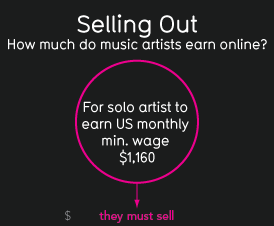
    Want to make a living a musician? Then make great music, press your own cd’s and sell them online. If you sell about 150 of them each month, you might make minimum wage. Any other road will mean you shouldn’t quite your day job. That’s the quick answer provided by graphs made by Information is Beautiful.

    Of course, this might be excluding any other amount of investments you need to make (recording the music, buying instruments), but still the picture painted is quite realistic. And it explains why record companies only seem to care about big artists who sell a lot. Their entire system is not only set up on making big artists even bigger, it’s their only tactic for survival and why they are shitting their pants about what’s happening on the internet.This is why they are using bogus arguments that even the US government is no longer buying.

    You may say Freeloaders are ruining entertainment, but let’s face it, copying is not theft. If you’re a self-respecting artist, be realistic. Make music because you love it, not because you have to make a living out of it. It’s nice if you can or at least make an extra buck, but never corner yourself in a position where you accuse your own fans of ripping you off. I know plenty of artists who don’t make an income off their art, but make an income to be able to make art. And there’s nothing wrong with that.

  • Blood Red Shoes: From DIY to ‘Professional’

    Over at Drowned in Sound, there’s an interesting article by/about the Blood Red Shoes and their top 10 list of advices to start DIY and become ‘professional’, although from their story, you start doubting how professional the supposed professionals are.