Tag: samples

  • Massive Attack – Unfinished Sympathy

    Going to do an easy one this week, since I got lost in a swamp of sample connections yesterday.

    In 1991 Massive Attack was temporarily named just ‘Massive‘ due to the outbreak of the Gulf War. Under that name they released Unfinished Sympathy. While a lot of the budget of the album went into the string arrangements of that song, it still leans on two samples as well.

    The hey-hey comes from the 1976 track Planetary Citizen by Mahavishnu Orchestra and John McLaughlin. It blends in quite nicely with the vocals by Shara Nelson in Unfinished Sympathy. The beats from the song are hidden between the drum rolls in the opening of the song Parade Strut (instrumental) by J.J. Johnson for the soundtrack of Willie Dynamite (1974).

    Interestingly, I had to correct the Wikipedia page for Unfinished Sympathy, because it stated that the bells in the song are from the famous (and often used) Take Me to the Mardi Gras by Bob James. Not only is the ring of the bells different, Unfinished Sympathy has the bells in 4 keys and the original Bob James sample only 2. Seriously, play them next to each other and tell the difference.
  • The Emotions – Best of My Love

    Sampling often leads to lawsuits and thus controversies. Usually it’s an open-and-shut case (for the court any how) when some sampled a bit of music directly and they didn’t get permission to use it from the owners of the rights to the original (which mind you isn’t necessarily the person performing the song or even the person who wrote it). But it becomes harder to do so when the original isn’t directly sampled but re-played.

    In 1977 R&B group The Emotions released the song Best of My Love which became a huge success. Like many songs by The Emotions and other R&B and funk artists, Best of My Love has been sampled a lot in in hiphop and dance music.

    Some simply sampled parts that make it clearly distinguishable, like 3rd Bass in Brooklyn-Queens (1989), King Bee in a Must Be the Music remix (1990), Full Force in Ain’t my Type of Hype (1990), Positive K’s Car Hoppers (1992), C.J. Lewis in Best of My Love (1994), Tamia’s Falling For You (1997), B-Rock & the Bizz in My Baby Daddy (1997), Cut Copy in Lights & Music. There’s even a rendition in a Sonic the Hedgehog game.

    More often though samplers focus on the “oww”-shout from that song. De La Soul did it in Say No Go (1989), Armand van Helden in Alright (1994), Nine in Whutcha Want (1995) and Deavid Soul in Miller Ball Breakers (2000).

    But the most interesting case comes from Mariah Carey who released the song Emotions in 1991. The song, though it doesn’t use any direct sample, is obviously inspired by and a tribute to Best of My Love. The title of the song Emotions is a bluntly obvious direct reference to the original artists The Emotions. Despite this, the original songwriter of Best of My Love, Maurice White, decided to sue the producers of Emotions, David Cole and Robert Clivilles otherwise known as C+C Music Factory. The matter was settled out of court and Mariah Carey would later sample another song by The Emotions, Blind Alley (1972), directly in Dreamlover (1993). I assume the rights to that one were nicely cleared beforehand.

  • A live practice run

    I just did a practice run for a live gig. It lasted 45 minutes and as to be expect it did not so go as well as I hoped. But hey it was a first run. I took notes and now have something to work on.

    So does this mean I have a live gig lined up? Not yet! But I do have plans. I’ll be submerged in my headphones the next few months and see if I can start doing some live gigs maybe after the summer. We’ll see. Gotta get better first.

    Meanwhile, you may remember this entry I did which included SL2? Richard Russell of XL Recordings mentioned the whosampled.com entry I made following that post on Twitter. Sweet.

  • Shocking Blue – Venus

    One of the biggest hits in the US by a Dutch artist is still Venus by Shocking Blue in 1969. It got re-popularized by the English girl-group Banarama when they covered it in 1986. In 1990 a ridiculous remix of Venus was released. The remix itself featured a few overused samples like Get up, Get Into It, Get Involved (1970) from James Brown, Think (1972) by Lynn Collins and Bring the Noise by Public Enemy (1987).

    Besides Bananarama it was also covered by Kirka in Finnish (1970), over-dramatically by Mina (1986), as a song about Jesus by ApologetiX (1998), by Singaporean singer Stefanie Sun (2002), by another Dutch band Krezip (2005) and even Jennifer Lopez did it for a razor blade commercial in 2010.

    But is Venus by Shocking Blue this week’s original? Nope, the song’s music is largely based on The Banjo Song by The Big 3 which included ‘Mama’ Cass Elliot who would later play in the Mama’s & the Pappa’s. But it goes even deeper. The Banjo Song itself is a very different musical arrangement around the lyrics of Oh! Susana by Stephen Foster which was originally released in 1848.  So in the end, Venus was based on the music from The Banjo Song which was based on the lyrics of Oh! Susana.

  • Edvard Grieg – In the Hall of the Mountain King

    Classical composer Edvar Grieg wrote In the Hall of the Mountain King for the play Peer Gynt which premiered in 1876. As such, it had a cinematic soundtrack quality to it, long before cinema became a broad popular pastime. Because of this it has long been a favorite background music for television and film. Most recently a rendition by Trent Reznor & Atticus Ross popped up on the award-winning soundtrack of The Social Network.

    A lot of musicians covered or sampled it, without it being specifically intended to accompany moving images. Notable covers are the versions by The Lancasters (titled Satan’s Holiday in 1965) ELO (1973), Apollo 100 as Mad Mountain King (1972) The Who (recorded in 1967, released in 1995), metal cello-quartet Apocalyptica (2000) and Epica (2009).

    But sampling it has been done quite a lot too. Whistle used the melody as a short hook in Just Buggin’ (1986). Master-sampler Coldcut featured a sample in Stop This Crazy Thing (1988) from (I think) the jazz-cover by Hugo Montenegro. Tango used it in the acid-track Can’t Stop the Rush. The song is among the classical tunes used in the title theme for the Sonic the Hedgehog-cartoon (1993). Vibes & Wishdokta used it in Motorway Madness (1996). A personal hardcore favorite: Juggernaut’s Ruffneck Rules da Artcore Scene (1996) Eurodance-artists Captain Jack used it in Dream a Dream (1999 and the 2009 version too). Delinquent Habits used it impressively in The Kind (1999). Most recently parts of it were used by Votchi in Unicorn (2004).

    As a bit of trivia, according to the Wikipedia-article the tune also served as the basis for the Inspector Gadget theme.

  • Bernard Purdie

    Last week I talked about Bernard Purdie’s song Soul Drums from 1968 which got sampled in Devil’s Haircut . The same track also got sampled in a Christmas track by Mansfield, entitled 2010.12.25 from 2000. Bernard Purdie is a session drummer who performed with people like James Brown, Aretha Franklin, BB King, Dizzy Gillespie, Miles Davis and Joe Cocker.

    Sampled drum breaks from Bernard Purdie songs are also in popular demand. The block rockin’ beats in Block Rockin’ Beats (1997) by the Chemical Brothers came from Purdie’s Changes from 1972. Interestingly the song was sampled before by Zhigge in Rakin’in the Dough (1992), but it used a bassloop. Changes itself is a cover of Them Changes (1970) by Buddy Miles.

    The Prodigy’s 3 Kilos (1994) samples Good Livin’ (Good Lovin’) (1972). The song 3 Kilos is on the album Music for the Jilted Generation. On the same album is Poison which contains a bunch of drum samples, one of them being Bernard Purdie’s Heavy Soul Singer (1972). The same sample can be heard faintly in the back ground on Massive Attack’s Mezzanine (1998).

    I mentioned Beck already, but his album Odelay contains another track, Hotwax, that samples Song for Aretha (1971) also by Bernard Purdie. Pepe Deluxe used the same sample in Lying Peacefully (2003).

    To top it off, Bernard Purdie himself ‘sampled’ too. His 1971 track Funky Mozart borrows the basics from Symphony #40 in G Minor by Mozart from 1788. That’s some old funky stuff.

    My personal favourite that contains a Purdie sample? Block Rockin’ Beats obviously:

  • Beck – Devil’s Haircut

    It’s interesting to see how some artists draw samples from the same artists and albums they have done before. Take Beck and his album Odelay, more specifically Devil’s Haircut from 1996. The track contains a lot of samples, which would take a few years to figure out. I’ll limit this post to three that stand out.

    Beck samples a band called Them (with singer Van Morrison) and he takes two samples from two separate tracks from the same album Them Again from 1966. One is I Can Only Give You Everything, the other Out of Sight. Interestingly, Beck’s album Odelay features another sample from Them Again. From It’s All Over Now, Baby Blue is used directly in Jack-Ass.

    Part of the drum loops comes from the excellent song Soul Drums from 1968 by Bernard Purdie. You kinda wonder why only Mansfield was the only to sample the same track in the song 2010.12.25 from 2000, since it’s such an excellent drum break which is so easy to sample. Not that Bernard Purdie never got sampled. He has been sampled a lot, but I’ll tell you all about that next week.

    For now here’s Devil’s Haircut with Them in it twice:

  • KLF – What Time Is Love?

    The KLF‘s track What Time Is Love (the Pure Trance 1 version) was originally released in 1988 and is an original acid house track. Their breakthru however came with a reworked version What Time Is Love (Live at Trancentral) in 1990. They described this track as “stadium house”. This version does however contain a few samples.

    The “I wanna see you sweat” sample comes from the track To the Bone by Wanda Dee released just 1 year earlier in 1989. Interestingly another sample from that track was used on the KLF’s Last Train to Transcentral.

    The KLF also used a sample of the MC5’s Kick out the Jams from 1969. This had a double meaning since The KLF had previously worked under the name The Justified Ancients of MuMu, which in turns was abreviated to The JAMs. There’s also a sample by Kraftwerk’s Home Computer (1981) hidden in the middle.

    After the  second release in 1990, the KLF also released a third version of the song entitled America: What Time Is Love? in 1991. This completely reworked version features a sample of Ace of Spades (1980) by Motörhead.

    In the wake of the three versions of the song followed a few interesting songs. The Ragga Twins sampled it in Wipe the Needle already in 1991. Scooter (sadly) sampled it not once, but twice in a song, like he pretty much rips off any dance track that was ever famous. In 1993 The God Machine made a industrial-metal cover.The most bizarre cover of the song is most certainly The Williams Fairey Brass Band cover of it in 1997. The KLF would later feature this on their Fuck the Millennium-single. Max Tundra has done a cover in 2006. Last but not least, The Kaiser Chiefs did a cover in 2006 for BBC Radio 1 and quite an excellent one at that.

  • C’hantal – The Realm

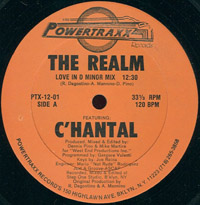
    In 1990 three guys, Anthony Mannino, Ralph D’Agostino & Dennis Pino, produced a laid-back, 12-minute long early house track under the name C’hantal entitled The Realm. A song that most likely would have disappeared in the pile of anonymous house tracks that filled the discotheques in the weekends back then. Except it didn’t because of one simple fact: the original vinyl record also featured an acapella track with just the vocals that were featured in the song. That made it perfect for sampling.

    Soon after, the rather pretentious lyrics of the Realm popped upin various other house tracks that would go on to become big club hits. Examples are Speedy J’s Something for your Mind (1991) and The Ultimate Seduction (1992) by The Ultimate Seduction (the guys that made the Turn up the Bass compilations) that even borrow their titles directly from the sample’s speech. The first record to sample the Realm however was the 1990 track Orgasm by Ursula Hybsch.

    After the success of Something for your Mind, many more dance tracks over the years plundered various parts of the sample. Noteable are Wet Like the Rain by The Bronx from 1997, Wrong is Right (1999) by DJ Jose & G-spott and Something 4 Your Mind (2008) by  Audio Junkies. There’s even a dubstep song titled Toasty (2008) by Reflect which briefly uses the sample.  In 1999 an artist named Dejure released the track Sanctuary and oddly enough it doesn’t use a sample but another girl speaking the lyrics. Might as well used the original.

    My personal favourite use of the sample: Something For Your Mind by Speedy J:

  • Human Resource – Dominator

    Let’s talk about a sample that isn’t a sample at all. Lady Gaga can and has been accused of a lot of things involving theft of other people’s music, but one thing that’s hardly ever done in her music is sampling. And by that I mean direct sampling; recording a loop and playing it back in your own track.

    There’s been outrage a few weeks back that Lady Gaga’s new single Born this Way would be creepily similar to Express Yourself (1989) by Madonna. By the way you can say Madonna borrowed parts of that song from Respect Yourself (1972) by The Staple Singers. I don’t want to get into the Born this Way/Express Yourself-discussion, but it reminded me of something going on a few years back when Bad Romance (2009) by Lady Gaga came out in The Netherlands.

    Apart from really hard to distinguish drumloop from Ballanation (2000) by DJ Jean, Bad Romance doesn’t use any samples. But Dutch people instantly recognised the ‘electronic saw’ noise in Bad Romance as a sample from one of Rotterdam’s finest classic rave formations Human Resource and their 1991 hit-single Dominator. If you Google “Lady Gaga Dominator” you can find a pile of discussions in Dutch about whether or not Lady Gaga stole the sample.

    Guess what? She didn’t. That distinct sound is what’s known as a ‘hoover’ among rave-lovers and is actually a preset on many synths, in this case the Roland Alpha Juno. It’s quite commonly used in rave and later hardcore tracks and you can find tons of videos of people recreating it. Even on a Casio.

    The Prodigy became famous for introducing the ‘hoover’-sound into the rave scene with their 1991 song Charly (you can see the Roland-synth in the video) and they certainly didn’t sample it from Human Resource either. It’s interesting considering the Prodigy have sampled a lot of people, but most of their synth-noises come straight from the electronics. I mean, the band is named after a synth, the Moog Prodigy for crying out loud.

    So: no, Lady Gaga did not sample the hoover from Human Resource: